
When joint discomfort, tendon irritation, or an old injury keeps getting in the way of the things you love, it can be frustrating to feel like your only options are to manage the symptoms or learn to live around them.
Maybe you have stopped playing as much golf because of your elbow. Maybe your knee is making your favorite hikes more difficult. Maybe an injury you thought was behind you keeps showing up every time you return to the gym.
At TPC Regenerative Health, we believe care should look beyond symptoms and consider what may be contributing to them.
One treatment that fits within this regenerative approach is prolotherapy.
What Is Prolotherapy?
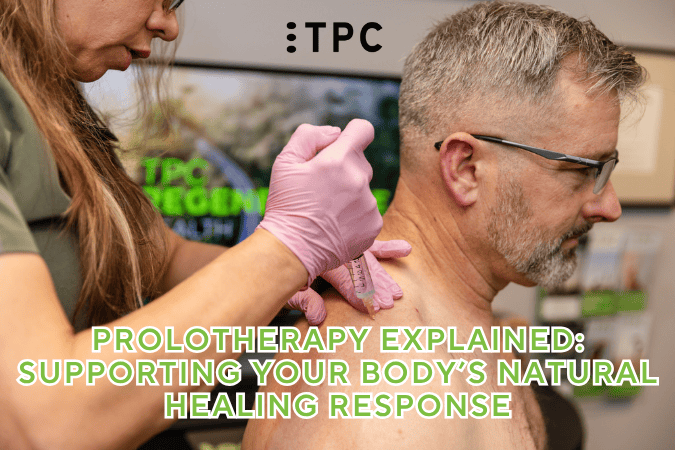
Prolotherapy is an injection based treatment designed to stimulate a localized healing response in targeted areas involving joints, tendons, and ligaments.
During treatment, your provider carefully injects a solution into specific areas they identify. The injection creates a controlled irritation that encourages the body to initiate its natural healing response.
The idea behind prolotherapy is different from treatments focused primarily on temporarily reducing discomfort.
Instead, prolotherapy is intended to support the tissues and structures that may be contributing to the problem.
How Does Prolotherapy Work?
Your body already has an incredible ability to respond to injury.
When tissue becomes injured or irritated, the body naturally begins a series of processes designed to protect and repair the affected area.
Prolotherapy works with that natural response.
The solution injected during prolotherapy creates controlled irritation within the targeted area. This stimulates a localized inflammatory response, which is one of the body’s natural first steps in the healing process.
That response may encourage repair and strengthening of the targeted tissues over time.
Because this process relies on the body’s natural response, prolotherapy is not designed to be an instant fix. Healing takes time, and some patients may require a series of treatments depending on their condition, health history, and individual response.
What Can Prolotherapy Be Used For?
Prolotherapy may be considered for a variety of musculoskeletal concerns involving joints, tendons, and ligaments.
Depending on the individual, a provider may consider prolotherapy for concerns such as:
• Knee discomfort
• Shoulder discomfort
• Hip discomfort
• Elbow concerns
• Tennis elbow
• Golfer’s elbow
• Tendon injuries
• Ligament injuries
• Joint instability
• Sports injuries
• Overuse injuries
• Certain chronic musculoskeletal concerns
Every patient and every injury is different.
Two people experiencing discomfort in the same area may have very different underlying issues. That is why an evaluation is an important part of determining what structures may be involved and whether prolotherapy is an appropriate option.
Why Consider a Regenerative Approach?
Managing symptoms can be an important part of healthcare, but regenerative medicine encourages us to ask another question:
How can we support the structures involved and the body’s natural healing processes?
That question is at the heart of prolotherapy.
Rather than focusing exclusively on what you are feeling today, the treatment is designed to stimulate a healing response within targeted tissues.
For some patients, this makes prolotherapy an option worth discussing when they are looking for a nonsurgical approach to persistent musculoskeletal concerns.
It Is Not Just About Pain. It Is About What Pain Is Keeping You From Doing.
One of the most important parts of treating a musculoskeletal problem is understanding how it affects your actual life.
Maybe you want to get back on the pickleball court.
Maybe you want to hike without constantly thinking about your knee.
Maybe you want to play 18 holes without your elbow becoming the focus of the day.
Maybe you want to exercise consistently again.
Or maybe you simply want everyday movement to feel easier.
At TPC Regenerative Health, these goals matter.
The goal of care is not simply to focus on a painful joint, tendon, or ligament. It is to understand what that problem is preventing you from doing and develop an individualized plan to help support your health and function.
Who Might Consider Prolotherapy?
You certainly do not have to be a professional athlete to experience an injury that affects your quality of life.
Prolotherapy may be worth discussing with a healthcare provider if an ongoing joint, tendon, or ligament concern is interfering with your ability to move comfortably, exercise, participate in recreational activities, or complete everyday tasks.
It may also be considered by people who have dealt with recurring musculoskeletal problems and want to explore additional treatment options.
The important question is not simply, “Do I have pain?”
It is also, “What is this keeping me from doing?”
What to Expect at TPC Regenerative Health
At TPC Regenerative Health, care begins with understanding the individual.
Your provider can evaluate the affected area, discuss your symptoms and health history, and work to identify what may be contributing to the problem.
From there, a personalized treatment plan can be developed based on your needs and goals.
Prolotherapy may be recommended on its own or considered alongside other regenerative and supportive treatments available at TPC Regenerative Health when appropriate.
The goal is to help patients explore options that support movement, function, and long term wellness.
Supporting Your Body’s Natural Ability to Heal 💚
Your body is constantly adapting, repairing, and rebuilding.
Regenerative medicine is about finding ways to work with those natural processes.
Prolotherapy offers one option for appropriate patients who want to look beyond temporary symptom management and explore a treatment designed to stimulate the body’s natural healing response.
Because ultimately, getting better is not just about feeling less discomfort.
It is about getting back to the life you want to live.
If an old injury, stubborn tendon problem, or joint concern is keeping you from doing the things you enjoy, contact TPC Regenerative Health to learn whether prolotherapy may have a place in your personalized care plan.